Swim

  • Even Coaches Can Benefit from UTC! – Heather’s Rockstar Story

    [vc_row][vc_column][vc_column_text]

    Rockstar Triathlete: Heather Shrouds

    Coaches Notes: Heather reached out in January, excited to be able to get such a great discount on Ultimate Tri Camp as a USAT certified USAT Coach, earn her CEUs, AND learn the “behind the scenes ” about how I coach my athletes and the Full Circle Coaching Methodology. 

    I love being able to support USA Triathlon coaches in the application of their knowledge.

    There are many different coaching styles, but with my 27 years of experience coaching thousands of triathletes and hosting over 20 triathlon camps, I believe that including training in more than just swimming, biking, and running is imperative to keeping a triathlete doing the sport they love for a lifetime. 

    At Camp, Heather saw firsthand how to coach the campers on the importance of technique in the swim, bike and running can prevent injuries from overusing the repetitive motion of a triathlon with the use of video analysis and metabolic field testing. Learning breath work, Kihara stretching, Eldoa spine strength, foot strength, and so much more can impact her triathlon performance and help her coach the athletes she is coaching. 

    Thanks, Heather, for coming in with an open mind and participating fully at Ultimate Tri Camp. You have so many new tools to implement into your coaching practice! You are a true Rockstar Coach/ and Camper!

    Age: 48

    Profession: Personal Trainer and Triathlon Coach

    Why did you choose Ultimate Tri Camp for help in your triathlon journey?
    I was at this triathlon camp to earn my CECs for my USAT Certification and improve my form in my swim and run. I knew something was off, but I was still determining what to expect. This was my first triathlon camp ever!

    Please share your BIG goals and how Ultimate Tri Camp supported you:
    My big goals are to swim 750m under 15 minutes, bike 20+mph, and run a 20-minute 5k
    I started my weight loss journey in the fall of 2009. I have lost 100 lbs so far. I fell in love with Triathlon after my first swim, even though I was terrified of the open water. Triathlon and Duathlon Worlds and I have qualified for and competed in Age Group Nationals.

    Tell me about your successes so far:

    Swim – being more efficient and converting to breathing every 2 strokes instead of 3
    Bike – getting my love back for riding outside.  I had been riding on the trainer a lot because of life schedule.   Riding in Clermont during Ultimate Tri Camp was beautiful, and riding in traffic was challenging, but I overcame my fear with the group’s safety.
    Run – seeing my form on video during the video analysis and the corrections we made.

    What were some of your biggest Improvements in performance at Ultimate Tri Camp?
    I learned even more about my gut health. I love the ELDOA, meditation, and yoga. Honestly, it all was excellent.
    1) Getting my love back for riding outside
    2) Recovery strategies 
    3) The Magnesium cream and Perfect Aminos are a game changer

    What was your favorite part of Ultimate Tri Camp?
    The camaraderie and the edge of competing with everyone—all of it, honestly. If I had to pick the ELDOAs, I have never done them before, but they’re a game changer for sure.

    Are you coming back next year?
    Yes, I plan on it!

    Ready to get your best time yet?! Here’s how you can get access to Ultimate Tri Camp!

    UTC 2025 will be held February 17-23, 2025 in Clearwater, Florida.

    As one of our valued subscribers, you can take advantage of 30% off of registration if you claim your spot before April 15, 2024.

    Click here to pay in full.

    Click here for the payment plan.

    Erinne Guthrie has been a USA Triathlon Level II Certified Coach since 1999 and Chief Motivating Officer at Full Circle Coaching, LLC since 2010. She has been training, racing, and coaching triathletes since 1997.  She is also a CHEK Holistic Lifestyle Coach Level 3, USMS Master’s Swim Coach, Motivational Speaker, Metabolic Efficiency Specialist, Mom, and more.

    [/vc_column_text][/vc_column][/vc_row]
  • From Heart Condition to Sprint Triathlon PR – Mark Fajet

    [vc_row][vc_column][vc_column_text]

    Rockstar Triathlete: Mark Fajet

    Coaches Notes:

    I was definitely a little concerned with Mark’s prior heart condition when we started training, so I was extremely conservative about his progression through the training program. Prioritizing technique over tons of volume and gradually adding speed work in all three sports has proved effective. His results below are amazing! I am so proud of you, Mark. You are a Rockstar Triathlete with a lot of potential in the sport. Thanks for trusting the process and being open to learning a better way to train!

    Age: 27

    Profession: Software Engineer

    Why did you choose FCC to help you on your triathlon/health and wellness journey?
    I wanted to do triathlons, but then I was diagnosed with pericarditis after going to the ER with heart pains. I managed to get through it with no training for months. Then I did a triathlon on my own, but my training for it was very calm as I was worried to push myself. I joined full circle because Erinne was very supportive of easing me into higher loads of training and safely pushing myself.


    What is your “A” race for this season?
    Ironman 70.3 Haines City, December 2024

    What are your BIG goals?
    Complete an Ironman 70.3 this year and a Full Ironman next year.

    What were some of your biggest improvements in performance for each of the following? Swim, Bike, Run, and Nutrition/Health. Please include any Personal Records and Goals achieved.our biggest improvements:
    In the beginning, I was setting goals of running a 5k in under 30 minutes. Five months later, after joining the Triathlon Transformation Program, I ran a 5k in 24:45 and a 5k at the end of a sprint tri in 27:25

    Before the program, my average bike pace at a sprint triathlon was 15.3mph. In the latest triathlon, my average pace was 19.96 mph.

    Beyond the timing numbers, the biggest improvement was in my ability to run while keeping my heart rate low and stay in zone 2. Before the program, I would be running like a 16 minute mile in zone 2. Now, I am around 12 minute miles while in zone 2.

    Name 2 or 3 things that have made the biggest difference in your journey.
    Consistency and pushing my limits. Prior to joining full circle, all my workouts were too easy and I wasn’t really making as much progress.

    What excites you the most about being involved in triathlon? 
    The fact that there is always room for improvement and that I can see what I’m able to achieve when I put in the work.

    What would you say to another person who was on the fence about joining our training program?
    The coaches are very knowledgeable. They are able to provide lots of general information, specific information for you, and even specific information about race courses.

    Do you want results like these?

    Click this link: http://www.scheduleyou.in/5ZIsVaU to schedule your FREE Triathlon Transformation Session today!

    Erinne Guthrie has been a USA Triathlon Level II Certified Coach since 1999 and Chief Motivating Officer at Full Circle Coaching, LLC since 2010. She has been training, racing, and coaching triathletes since 1997.  She is also a CHEK Holistic Lifestyle Coach Level 3, USMS Master’s Swim Coach, Motivational Speaker, Metabolic Efficiency Specialist, Mom, and much more.

    [/vc_column_text][/vc_column][/vc_row]
  • Are You Swimming with Scissors?

    Are you swimming with scissors?

    Many swimmers and triathletes I work with don’t realize they are slowing themselves down while swimming due to using a scissor-style kick instead of a flutter kick.

    Here are my top three corrective tips to cure your scissor kick.

    A scissor kick is when your feet drift apart wider than the width of your shoulders while you swim freestyle which creates a ton of drag every time you kick,  impeding your forward movement.

    The best flutter kick originates from the hips and stays within shoulder width in a vertical format.

    Top 3 Tips to improve your kick

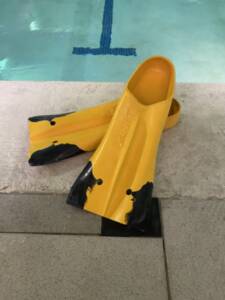
    #1 FINS: Use fins for kick sets to help strengthen the ankles and hips. This is my favorite brand and model (Finis Z2 Gold Zoomers)

    The flutter kick should be originating from the hips through an almost straight leg and down to a floppy ankle with a slightly pointed foot.

    If you are scissor kicking, it indicates tight and weak ankles and hips.  Using fins for the following kick drills can help get rid of your scissor kick.

    SAMPLE WORKOUT: Kick 100 yards with fins. – the first 25 kicks on your belly, the second 25 kicks on your side, the third 25 kicks on your back, and the last 25 kicks on the other side. 

    Watch the video below:

    BONUS PRACTICE: Repeat another 100 yards, all using a Dolphin Kick.

    #2 VERTICAL KICKING must have a deep pool.
    Start with fins and build up to 1 minute of vertical kicking time, adding rotation
    1/4, 1/2, and whole turns to the right and the left while staying in one place is key.
    Then, start practicing without fins and get to 1 minute of vertical kick time.

    Watch the video below:

    #3 DRY LAND FLUTTER KICKING – great for increasing hip and core strength
    Lay on your back – palms down, tucked under your thighs. Chin to chest, head and shoulders off the ground. Lift straight legs off the ground and flutter kick with strong quads, straight knees, and pointed toes for 1 minute. Vary the speed of kicking to mix it up and challenge yourself.

    Watch the video below:


    WANT TO LEARN ALL THE MOST CRITICAL SKILLS FOR SWIMMING?

    YOU CAN AT SWIM ESSENTIALS FEBRUARY 17 & 18!

    Don’t let poor technique be the anchor that holds you back from your swimming aspirations!

    Join me at the Swim Essentials Clinic on February 17 & 18, either in person or virtually. When you sign up now, you’ll also gain exclusive access to my Swim Essentials online course, brimming with expert tips and techniques to elevate your swimming prowess.

    Don’t miss out—act now and take the first step toward becoming the swimmer you’ve always aspired to be!

    SPACE IS LIMITED!

    Save $100 on registration by using promo code SWIM100! SIGN UP HERE!

    Do you have other questions? Click this link: https://go.appointmentcore.com/book/umg5sS to schedule your FREE Triathlon Breakthrough Session.

    Erinne Guthrie is a USA Triathlon Level II Certified Coach since 1999 and Chief Motivating Officer at Full Circle Coaching, LLC since 2010. Creator of the Triathlon Transformation. She has been training, racing, and coaching triathletes since 1997.  She is also a CHEK Holistic Lifestyle Coach Level 3, USMS Master’s Swim Coach, Motivational Speaker, Metabolic Efficiency Specialist, Mom, Mermaid, and much more.

  • Swimmers: How’s Your Head?

    Proper head position while swimming freestyle is probably the most common thing that needs correction when I work with swimmers.

    99% of swimmers look forward instead of straight down in a neutral head and neck position.

    Can you imagine walking around looking up all day?
    Your neck would hurt, and you would miss out on a lot right in front of you!

    When you look forward in the water, your forehead breaks the surface of the water (creating drag), and then your hips and legs drop low, also creating drag.

    Then when you turn your head to breathe, your mouth is underwater, so you lift your head even higher to get air, and guess what? More drag, more resistance as you swim through the water! NOT FUN!

    This is one of the reasons head-up swimmers are slower in the water- too much resistance slowing them down.

    But there is a good explanation: swimming with your head up is where most new swimmers start.

    We are land mammals and need air to live, and being in water can cause stress in our brains, we could die if we don’t know what we are doing, so the fear is real!

    In addition, your fight-or-flight hormones can get triggered simply by being in the water unless you have adequately trained and built your confidence so you feel safe in the water.

    The brain will tell the body, “the air is up, so you must lift your head to breathe.” But, as mentioned above, this causes drag and makes slipping through the water in your streamline difficult.

    We must reprogram the brain, so it feels safe to face down in the water. Teach yourself to roll on your side rather than lift your head to breathe (look for my other swim technique videos on how to breathe properly while swimming in the water).

    The Paddle Lead Drill:

    This video will help you gain awareness of the perfect place for your head while swimming. With this drill, you can perfect your head position for less drag and still get all the air you need.

    • Start by kicking with fins on, arms by your side, and placing the paddle on the top of your head. 
    • Your forward movement will keep the paddle in place. Next, start face down, blow your bubbles, and flip onto your back to breathe, keeping the paddle in place.
    • The next progression is to kick on your side with the paddle on your head. Start by looking straight down and blowing bubbles out of your nose, then turn your head to the side to breathe without lifting the head and losing the paddle.
    • Turn the head so that one goggle and your mouth are clear of the water to breathe in, then look back down to the bottom of the pool and repeat the process. Be sure to practice both sides.

    When you have mastered the above, add your arm movement and swim freestyle, still keeping the paddle in place, breathing, and stroking.

    When the paddle stays in place the whole time, and you are not swallowing water, you know your head is in the correct position!

    Finally, remove the fins and start the whole process over again.

    Happy Swimming.


    WANT TO LEARN ALL THE MOST CRITICAL SKILLS FOR SWIMMING?

    You CAN at Swim Essentials February 17 & 18!

    Don’t let poor technique be the anchor that holds you back from your swimming aspirations!

    Join me at the Swim Essentials Clinic on February 17 & 18, either in person or virtually. When you sign up now, you’ll also gain exclusive access to my Swim Essentials online course, brimming with expert tips and techniques to elevate your swimming prowess.

    Don’t miss out—act now and take the first step toward becoming the swimmer you’ve always aspired to be!

    SPACE IS LIMITED!

    Do you have other questions? Click this link: https://go.appointmentcore.com/book/umg5sS to schedule your FREE Triathlon Breakthrough Session.


    Erinne Guthrie has been a USA Triathlon Level II Certified Coach since 1999 and Chief Motivating Officer at Full Circle Coaching, LLC since 2010. She has been training, racing, and coaching triathletes since 1997.  She is also a CHEK Holistic Lifestyle Coach Level 3, USMS Master’s Swim Coach, Motivational Speaker, Metabolic Efficiency Specialist, Mom, and much more.

  • Have You Been Told These Lies About Swimming?

    Have you heard these lies before?

    “I’m not supposed to kick as a triathlete.”
    “I need to save my legs for the bike and run.”


    These lies are simply not true!

    Your kick is an essential part of your freestyle swim that you cannot and must not leave out.

    The secret is that you need to develop your kick 🦵 and make it efficient, so you don’t waste so much energy doing it!

    Most triathletes have terrible balance in the water. 
    Are you one of them?

    This means you are swimming with your head up and your legs dragging. 

    No wonder you are tired!

    But it’s NOT from kicking; it’s from a lack of balance in the water and an inefficient kick. 

    A good kick improves your balance, so you are not dragging your legs thru the water.

    Three things to look and feel for in your freestyle kick.

    1) Are you bending your knees too much instead of kicking from your hips?

    Most triathletes often run and bike, so they are strong with their knees bent. However, to flutter kick well, you need to kick from your hips, keeping your knees mostly straight, with a whip-like motion from the hips. Ankles need to be supple and flexible too!

    2) Are your heels breaking the surface of the water?

    If not, then you are dragging your legs…

    I use the analogy of a motor boat with the engine on but without enough power to get it up on a plane so it has less resistance and can glide through the water.

    When flutter kicking correctly, your heels and ankles should lightly break the water’s surface- like a gentle boil. There should not be big huge splashes or your whole foot kicking the air. Instead, you need to keep your feet in the water kicking the water.

    3) Are your ankles flexible and floppy so your foot can provide up-and-down propulsion in the water?

    Getting a swim video analysis is the best way to witness your kick inefficiencies and learn to correct them.

    Come learn how to kick correctly at my upcoming Swim Essentials Clinic for video analysis and 12 hours of coached swim training in the pool, open water, and online.

    I am hosting a Swim Essentials Clinic February 17-18th…
    WILL YOU BE JOINING US?

    If you are ready to start swimming the right way, now is the time to take charge of your swimming and learn my step-by-step process of learning how to swim the right way.

    • Swim-specific strength and mobility
    • The exact things you need to do with your head, hands, arms, legs
    • Stop swallowing a mouth full of water with every head turn to breathe.
    • No more anxiety and panic while you swim
    • How to conserve your energy

    With my step-by-step program, you can guarantee improved swim performance and reach your desired swim goals. Assessing your current skills and setting clear performance goals will provide a roadmap for your training.

    It’s an amazing opportunity to be in the water with our coaches and get hands-on instruction to power up your swim!

    REGISTRATION OPENS NEXT WEEK!

    If you know Swim Essentials is for you, Send me an email at info@fullcirclecoaching.com to get on the waitlist!


    Erinne Guthrie has been a USA Triathlon Level II Certified Coach since 1999 and Chief Motivating Officer at Full Circle Coaching, LLC since 2010. Creator of the 16-week Triathlon Transformation. She has been training, racing, and coaching triathletes since 1997.  She is also a CHEK Holistic Lifestyle Coach Level 3, USMS Master’s Swim Coach, Motivational Speaker, Metabolic Efficiency Specialist, Mom, Mermaid, and much more.

  • Beat the Heat! How to train and race when it’s HOT outside!

    Beat the Heat! How to train and race when it’s HOT outside!

    It is HOT! The hottest it’s ever been in the history of the world, according to the news!

    Please be careful when training in the heat.

    Training in the heat can cause excess dehydration, high heart rates, heat stroke, and death! But you can do lots of things to help your body handle the heat and still be able to train and race.

    • Practice training in the heat gradually. Start with 15-30 minutes and increase based on your race distance. This can help your body acclimate to higher temperatures. It’s a good idea to plan some of your training at the exact time of day you will be racing so your body gets used to the heat both mentally and physically.
    • Sauna- sitting in a sauna post-workout for 15 minutes, building up to 20-30 minutes, can help you get used to the heat as well. If possible, do not drink water while in the sauna, but please hydrate per a post sauna.
    • Hydrate and fuel a little extra than you think you should. Your body uses more calories and energy to keep core body temperatures down. I suggest sips of cool hydration every 10 minutes minimum in general while training, but especially if the heat is on.
    • Add extra sea salt to your food and in your water bottles. Remember to add a good-quality electrolyte mix. My favorite is the watermelon electrolyte supplement from Body Health. Organic coconut water is also helpful for added electrolytes.
    • Cooler drinks can help while training in the heat, but be careful with cramping in the stomach if the drink is too cold; one tip is to hold the ice water in your mouth for a few seconds before swallowing and take smaller sips.
    • Cool towels and sponges are sometimes offered on the race course. Using this in training works great too! Apply them to your forearms, forehead, back of your neck, and crotch area- be careful not to get your socks wet in your shoes which can cause blisters. Cool forearm sleeves can also be helpful.
    • Pre-Cooling- being in air conditioning or under a fan before training or racing can help you handle the heat longer.
    • Keep your face shaded with a visor instead of a closed-off baseball cap, and stay away from black helmets and race and training kits; black increases heat!
    • Never skip an aid station on the race course; reduce your pace to keep moving forward as needed.

    I used every single one of these tips while riding across the desert during RAAM last year. They make a big difference for me and my athletes racing warmer races.

    Happy heat training and racing!

    Join my private Facebook group, Triathlon Obsessed, for tons of tips and triathlon support!

    If you’re curious about what’s possible with your training, schedule your FREE Triathlon Breakthrough Session and let’s do it! Click here: http://www.scheduleyou.in/5ZIsVaU 

    Erinne Guthrie is a USA Triathlon Level II Certified Coach since 1999 and Chief Motivating Officer at Full Circle Coaching, LLC since 2010. Creator of the 16 week Triathlon Transformation. She has been training, racing and coaching triathletes since 1997.  She is also a CHEK Holistic Lifestyle Coach Level 3, USMS Master’s Swim Coach, Motivational Speaker, Metabolic Efficiency Specialist, Mom, Mermaid and much much more.

  • Are you breathing the right way when you swim?

    Are you breathing the right way?

    WATCH!

    Breathing…
    Seems like we, as land mammals, should know how to do this instinctually, but unfortunately, that’s not the case.

    So many factors affect our breathing on land, let alone doing it well while swimming.

    This single skill can affect everything you do in the water.

    If we’re breathing effectively while we swim, we can perform the necessary movements to swim effectively.

    It’s important to breathe while swimming as similar as you do on land.

    There should be no breath-holding.

    When your face goes underwater, aim to blow bubbles out of your nose for 3 seconds, calmly.

    Inhaling through your mouth and exhaling through your nose, most of the time, is key to a calm, efficient breathing pattern and swimming success.

    Getting a swim video analysis is the best way to witness your kick inefficiencies and learn to correct them.

    Come learn how to kick correctly at my upcoming Swim Essentials Clinic for video analysis and 12 hours of coached swim training in the pool, open water, and online.

    ARE YOU JOINING US FOR SWIM ESSENTIALS on Saturday, March 25th –
    Want to learn more of my best swim tips…

    If you are ready to start swimming the right way, now is the time to take charge of your swimming and learn my step-by-step process of learning how to swim the right way.

    • Swim-specific strength and mobility
    • The exact things you need to do with your head, hands, arms, legs
    • Stop swallowing a mouth full of water with every head turn to breathe.
    • No more anxiety and panic while you swim
    • How to conserve your energy

    With my step-by-step program, you can guarantee improved swim performance and reach your desired swim goals. Assessing your current skills and setting clear performance goals will provide a roadmap for your training.

    Click for complete details & registration!

    It’s an amazing opportunity to be in the water with our coaches and get hands-on instruction to power up your swim!

    Erinne Guthrie has been a USA Triathlon Level II Certified Coach since 1999 and Chief Motivating Officer at Full Circle Coaching, LLC since 2010. Creator of the 16-week Triathlon Transformation. She has been training, racing, and coaching triathletes since 1997.  She is also a CHEK Holistic Lifestyle Coach Level 3, USMS Master’s Swim Coach, Motivational Speaker, Metabolic Efficiency Specialist, Mom, Mermaid, and much more.

  • Have you been told this lie about your swimming?

    Have you been told this lie about your swimming?

    Have you heard these lies before?

    “I’m not supposed to kick as a triathlete.”
    “I need to save my legs for the bike and run.”

    These lies are simply not true!

    Your kick is an essential part of your freestyle swim that you cannot and must not leave out.

    The secret is that you need to develop your kick 🦵 and make it efficient, so you don’t waste so much energy doing it!

    Most triathletes have terrible balance in the water. 
    Are you one of them?

    This means you are swimming with your head up and your legs dragging. 

    No wonder you are tired!

    But it’s NOT from kicking; it’s from a lack of balance in the water and an inefficient kick. 

    A good kick improves your balance, so you are not dragging your legs thru the water.

    Three things to look and feel for in your freestyle kick.

    1) Are you bending your knees too much instead of kicking from your hips?

    Most triathletes often run and bike, so they are strong with their knees bent. However, to flutter kick well, you need to kick from your hips, keeping your knees mostly straight, with a whip-like motion from the hips. Ankles need to be supple and flexible too!

    2) Are your heels breaking the surface of the water?
    If not, then you are dragging your legs…

    I use the analogy of a motor boat with the engine on but without enough power to get it up on a plane so it has less resistance and can glide through the water.

    When flutter kicking correctly, your heels and ankles should lightly break the water’s surface- like a gentle boil. There should not be big huge splashes or your whole foot kicking the air. Instead, you need to keep your feet in the water kicking the water.

    3) Are your ankles flexible and floppy so your foot can provide up-and-down propulsion in the water?

    Getting a swim video analysis is the best way to witness your kick inefficiencies and learn to correct them.

    Come learn how to kick correctly at my upcoming Swim Essentials Clinic for video analysis and 12 hours of coached swim training in the pool, open water, and online.

    ARE YOU JOINING US FOR SWIM ESSENTIALS?
    Want to learn more of my best swim tips…

    If you are ready to start swimming the right way, now is the time to take charge of your swimming and learn my step-by-step process of learning how to swim the right way.

    • Swim-specific strength and mobility
    • The exact things you need to do with your head, hands, arms, legs
    • Stop swallowing a mouth full of water with every head turn to breathe.
    • No more anxiety and panic while you swim
    • How to conserve your energy

    With my step-by-step program, you can guarantee improved swim performance and reach your desired swim goals. Assessing your current skills and setting clear performance goals will provide a roadmap for your training.

    Click for complete details & registration!

    It’s an amazing opportunity to be in the water with our coaches and get hands-on instruction to power up your swim!

    Erinne Guthrie has been a USA Triathlon Level II Certified Coach since 1999 and Chief Motivating Officer at Full Circle Coaching, LLC since 2010. Creator of the 16-week Triathlon Transformation. She has been training, racing, and coaching triathletes since 1997.  She is also a CHEK Holistic Lifestyle Coach Level 3, USMS Master’s Swim Coach, Motivational Speaker, Metabolic Efficiency Specialist, Mom, Mermaid, and much more.
  • Are You Swimming with Scissors?

    Are you swimming with scissors?

    Many swimmers and triathletes I work with don’t realize they are slowing themselves down while swimming due to using a scissor-style kick instead of a flutter kick.

    Here are my top three corrective tips to cure your scissor kick.

    A scissor kick is when your feet drift apart wider than the width of your shoulders while you swim freestyle which creates a ton of drag every time you kick,  impeding your forward movement.

    The best flutter kick originates from the hips and stays within shoulder width in a vertical format.

    Top 3 Tips to improve your kick.
    swimming fins to improve speed

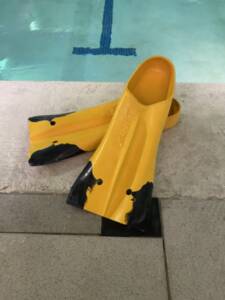
    1- Fins, use fins for kick sets to help strengthen the ankles and hips. This is my favorite brand and model (Finis Z2 Gold Zoomers)

    The flutter kick should be originating from the hips through an almost straight leg and down to a floppy ankle with a slightly pointed foot.

    If you are scissor kicking, it indicates tight and weak ankles and hips.  Using fins for the following kick drills can help get rid of your scissor kick.

    Sample Workout: Kick 100 yards with fins. – the first 25 kicks on your belly, the second 25 kicks on your side, the third 25 kicks on your back, and the last 25 kicks on the other side.  Watch my video here

    Bonus practice; Repeat another 100 yards, all using a Dolphin Kick.

    2- Vertical kicking must have a deep pool.
    Start with fins and build up to 1 minute of vertical kicking time,
    adding rotation
    1/4, 1/2, and whole turns to the right and the left while staying in one place is key.
    Then, start practicing without fins and get to 1 minute of vertical kick time.
    Watch my video here

    3- Dryland flutter kicking – great for increasing hip and core strength
    Lay on your back – palms down, tucked under your thighs
    Chin to chest, head and shoulders off the ground
    Lift straight legs off the ground and flutter kick with strong quads, straight knees, and pointed toes for 1 minute. Vary the speed of kicking to mix it up and challenge yourself.
    Watch my video here

    Our Swim Essentials Program starts March 25th; come join us!

    It’s an amazing opportunity to be in the water with our expert coaches getting hands-on instruction to power up your swim!

    Ready to sign up… please link HERE for all the details.


    Use this link to schedule your FREE Triathlon Breakthrough Session: http://WWW.SCHEDULEYOU.IN/5ZISVAU

    Erinne Guthrie is a USA Triathlon Level II Certified Coach since 1999 and Chief Motivating Officer at Full Circle Coaching, LLC since 2010. Creator of the Triathlon Transformation. She has been training, racing, and coaching triathletes since 1997.  She is also a CHEK Holistic Lifestyle Coach Level 3, USMS Master’s Swim Coach, Motivational Speaker, Metabolic Efficiency Specialist, Mom, Mermaid, and much more.

  • How’s your head?

    How’s your head?

    Proper head position while swimming freestyle is probably the most common thing that needs correction when I work with swimmers.

    99% of swimmers look forward instead of straight down in a neutral head and neck position.

    Can you imagine walking around looking up all day? Your neck would hurt, and you would miss out on a lot right in front of you!

    When you look forward in the water, your forehead breaks the surface of the water (creating drag), and then your hips and legs drop low, also creating drag.

    Then when you turn your head to breathe, your mouth is underwater, so you lift your head even higher to get air, and guess what? More drag, more resistance as you swim through the water! NOT FUN!

    This is one of the reasons head-up swimmers are slower in the water- too much resistance slowing them down.

    But there is a good explanation: swimming with your head up is where most new swimmers start.

    We are land mammals and need air to live, and being in water can cause stress in our brains, we could die if we don’t know what we are doing, so the fear is real!

    In addition, your fight-or-flight hormones can get triggered simply by being in the water unless you have adequately trained and built your confidence so you feel safe in the water.

    The brain will tell the body, “the air is up, so you must lift your head to breathe.” But, as mentioned above, this causes drag and makes slipping through the water in your streamline difficult.

    We must reprogram the brain, so it feels safe to face down in the water. Teach yourself to roll on your side rather than lift your head to breathe (look for my other swim technique videos on how to breathe properly while swimming in the water).

    The Paddle Lead Drill in this video will help you gain awareness of the perfect place for your head while swimming. With this drill, you can perfect your head position for less drag and still get all the air you need.

    -Start by kicking with fins on, arms by your side, and placing the paddle on the top of your head. 

    -Your forward movement will keep the paddle in place. Next, start face down, blow your bubbles, and flip onto your back to breathe, keeping the paddle in place.

    -The next progression is to kick on your side with the paddle on your head. Start by looking straight down and blowing bubbles out of your nose, then turn your head to the side to breathe without lifting the head and losing the paddle.

    -Turn the head so that one goggle and your mouth are clear of the water to breathe in, then look back down to the bottom of the pool and repeat the process. Be sure to practice both sides.

    When you have mastered the above, add your arm movement and swim freestyle, still keeping the paddle in place, breathing, and stroking.

    When the paddle stays in place the whole time, and you are not swallowing water, you know your head is in the correct position!

    Finally, remove the fins and start the whole process over again.

    Happy Swimming.

    Want to learn all the most critical skills for swimming? My Swim Essentials Program starts March 25th.

    Click HERE for complete details & registration!

    Do you have other questions? Click this link: http://www.scheduleyou.in/5ZIsVaU to schedule your FREE Triathlon Breakthrough Session.

    Erinne Guthrie has been a USA Triathlon Level II Certified Coach since 1999 and Chief Motivating Officer at Full Circle Coaching, LLC since 2010. She has been training, racing, and coaching triathletes since 1997.  She is also a CHEK Holistic Lifestyle Coach Level 3, USMS Master’s Swim Coach, Motivational Speaker, Metabolic Efficiency Specialist, Mom, and much more.